
本文是一篇语言学论文,本文认为,基式动词到动词重叠式之间的界性调整可进一步解释动词重叠式的附加语义,并提出,动词重叠式具有增减共存的附加语义。
Chapter One Introduction
1.1 Research Background and Research Object
Verb reduplication is a special composite structure within the verb category, characterized primarily by the following two aspects: First, the transformation of a base verb into verb reduplication involves morphological changes, achieved through the repetition of a verb to represent the superposition of two verbs with identical lexical meanings and forms. Second, the superposition of these two verbs with identical lexical meanings results in a semantic difference from the base verb; that is, the reduplicated verb must acquire additional meanings to be considered a true verb reduplication (He Rong, 1962). As verb reduplication, it must simultaneously exhibit both of these feature.
The question of which forms can be termed verb reduplication is a fundamental issue that linguists must first clarify when studying verb reduplication. It is generally accepted that verb reduplication includes forms such as “V一V”, “V了V”, and “VV”, among others. The academic community largely agrees that “VV” represents the most basic form of verb reduplication, formed directly through the morphological superposition of the verb “V” (Chang Jian, 1981; Zhu Dexi, 1982). Verb reduplication has only one form, which is “VV”. Li Renjian (1964) pointed out that there should be no phonological pause within verb reduplication, and no elements can be inserted between the verbs in verb reduplication. Only when the verb “V” is reduplicated into “VV” without any intervening elements does it qualify as verb reduplication. Shi Youwei (1997) also contends that, in a strict sense, verb reduplication exists in only one form, that is, the “VV” form. This thesis adopts the above viewpoints, positing that only a form in which two verbs are formally repeated and closely connected without any other components in between can be called verb reduplication, and there is only the “VV” form.
.......................
1.2 Research Questions
This study, based on the bounded exhibited by verb reduplication, explores the boundedness adjustments that occur when the base verb undergoes reduplication. It aims to address the following three questions:
(1) What are the commonalities and differences in boundedness between the base verbs and verb reduplication?
(2) When a base verb combines with a reduplicated verb, how is the boundedness adjustment of the verb reduplication achieved?
(3) How does verb reduplication achieve its additional semantics of “coexistence of diminution and augmentation” during the process of boundedness adjustment?
语言学论文怎么写
....................
Chapter Two Literature Review
2.1 Foreign Research
It should be noted that verb reduplication is not unique to the Chinese language. As a grammatical device, reduplication is widely distributed across many languages in the world’s major language families. Zhang Min (1997) found that almost every morphological pattern of reduplication in Chinese has appeared in one or several other languages, and the core semantics expressed by Chinese reduplication are also found in other languages. Moreover, other languages contain a large number of reduplication patterns and semantic types that do not exist in Chinese. This indicates that the semantics of reduplication have universality and are not arbitrary.
Most foreign scholars have approached the semantics of verb reduplication from the perspective of linguistic iconicity. They have pointed out that verb reduplication can express meanings such as plurality or intensity. According to Edward Sapir (1921), reduplication, or the repetition of all or part of a root element, is a natural and widespread phenomenon across languages. This grammatical process is generally used to convey concepts such as dispersion, plurality, repetition, habitual actions, extension of volume, increased intensity and continuity. Wang Shu (2016) interprets two key points from Sapir’s statement: 1. The symbolism of reduplication as a grammatical mechanism is highly evident; 2. The semantics of reduplication express an increase in quantity, at least initially, when reduplication first emerges. This understanding of reduplication is not unique to Sapir. Friedrich (1979) also pointed out that reduplication contains a certain degree of iconicity. Tai (1993) explicitly proposed the concept of “reduplicative iconicity” and defined it as follows: the reduplication (repetition) of linguistic expressions corresponds to the reduplication (repetition) in the conceptual domain. From the perspectives of iconicity and lexical category shift, reduplicative forms and their semantics exhibit metaphorical iconicity. The complete repetition in form represents the accumulation and superposition of the same “action quantity”, which can also be seen as the stacking of “object quantity”. The reduplication of Chinese forms mimics the stacking of objects in reality, and the repetition and extension of verbs correspond to the superposition and expansion of “object quantity”. Hiraga (1994: 11) also explicitly stated: “There is an iconic relationship between the quantity of form and the quantity of meaning; the larger the form, the greater the meaning”. Reduplication expands the form, and the expansion of the form corresponds to an increase in quantity.
.....................................
2.2 Domestic Research
Due to the special form, lasting development, and widespread use of the verb reduplication in Chinese, domestic scholars have studied the semantics of Chinese verb reduplication from different perspectives.
2.2.1 Semantics and Forms of Verb Reduplication
In domestic research, some scholars have determined the forms of verb reduplication by studying its semantics. In linguistic studies, form and meaning are closely interconnected. Therefore, when investigating the forms of verb reduplication, some scholars start from its semantics, arguing that the existing forms of verb reduplication can be divided into two main schools: One category is represented by Shi Youwei (1997), who advocates a narrow view of the form of verb reduplication. According to this perspective, the form of verb reduplication is limited to the “VV” form, which is derived from the base verb through form repetition. For example, monosyllabic verbs follow the “VV” form, while disyllabic verbs follow the “V1V2V1V2” form. Shi Youwei explains that, despite the emergence of various forms of verb reduplication in the academic community, the “VV” form is associated with longer durations, more formal attitudes, and more frequent repetitive actions. Therefore, verb reduplication conveys the meaning of “augmentation”. In a strict sense, there is only one form of verb reduplication, which is the “VV” form. Another category is represented by He Rong and Fan Fanglian, who advocate a broader view of the forms of verb reduplication. They argue that verb reduplication is not limited to a single form. In addition to the “VV” form, other expanded forms based on the reduplication of verbs, such as “V一V” and “V了V”, can also be considered as verb reduplication.
...........................
Chapter Three Theoretical Framework ............................ 25
3.1 Boundedness Theory .................................................. 25
3.2 Construal ............................... 31
Chapter Four Boundedness in the Base Verb and Verb Reduplications: Commonalities and Differences ..................... 45
4.1 The Boundedness of Verb ..................................... 45
4.2 The Boundedness of the Base Verb ............................... 50
Chapter Five Boundedness Adjustment in the Compositional Path of Verb Reduplication ............................... 73
5.1 The Role Assignment of Internal Components in Verb Reduplication ................... 73
5.2 The Base in Boundedness Adjustment ......................... 75
Chapter Six The Explanation of Additional Semantics in Cognitive Motivation
6.1 Cognitive Motivation in Boundedness Adjustment
Langacker (2008) pointed out that the boundary depends on the construal mode of the cognizer. From the perspective of people’s cognitive patterns, people are influenced by Gestalt psychology during the cognitive construal process. Under the effect of the law of Pragnanz, people always construe all the things and events they perceive as a complete and bounded entity. Based on this view, all action events can be processed by the cognizer as having endpoints, depending on the subject’s construal dimensions to the action events, and such construal dimensions are reflected in language expressions.
Combining with the collocation features presented in the language expressions where verb reduplications are located, verb reduplication can be regarded as follows: under the influence of the construal operations, driven by the law of Pragnanz, the cognizer establishes a gestalt for the action event under his or her control during the construal process and sets a stopping point for this action event. Due to the explicit subjectivity controllability presented by verb reduplication, the action event it represents is first manifested as the cognizer mentally attaching a stopping point to this action event.
This means that the action event first has a processing time, and the processing time precedes the conceived time. Therefore, the action event represented by verb reduplication has an uncertain termination point. Subsequently, when this action event is presented through a language expression, its processing time correspondingly activates the conceived time. Under the dominance of the principle of linguistic economy, the cognizer chooses to use the lexical form representing the same action to mark the stopping of the event. This process not only reflects the conciseness of language expression but also further paves the way for the semantics of verb reduplication, enabling it to achieve consistency between the linguistic form and the semantic content.
语言学论文参考
..........................
Chapter Seven Conclusion
7.1 Major Findings
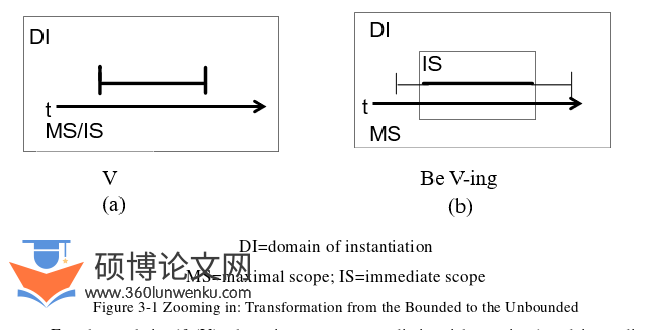
The most crucial aspect of studying boundedness adjustment of verb reduplication lies in clarifying the commonalities and differences between verb reduplication and the base verb. The commonalities and differences between verb reduplication and the base verb determine that their semantics can be dynamically constructed under the construal operations. Based on this perspective, this study finds a distinction between the bounded and the unbounded in verb reduplication and the base verb: All verb reduplications are the bounded, whereas the base verb exhibits the bounded and the unbounded.
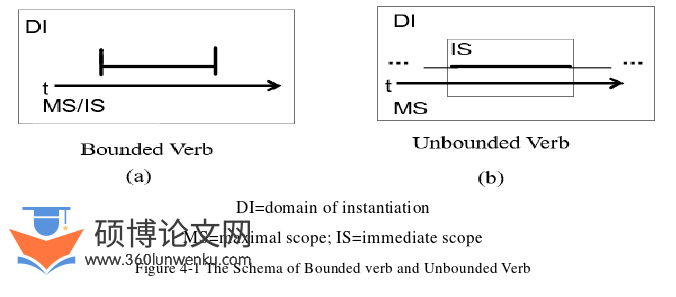
Firstly, this thesis examines the differences in boundedness between base verbs and verb reduplications from the schematic characteristics of verbs and formal collocations. Based on construal and boundedness theory, according to the schematic characteristics of verbs, this thesis classifies base verbs into two major categories and three minor categories: base verbs can be divided into bounded and unbounded types. Based on the classification of the bounded and the unbounded, a secondary classification can be further carried out according to the internal characteristics: According to whether there is internal continuity within the bounded base verbs, bounded verbs are divided into accomplishment verbs and instant-completion verbs. Through the retrieval in the BCC corpus, it is found that only accomplishment verbs with internal continuity characteristics can fall within the range of reduplication. According to the different ways of presenting homogeneity and internal continuity presented within the unbounded base verbs, unbounded verbs are divided into activity verbs and state verbs.
Then, this thesis analyzes the commonalities between verb reduplication and the base verb, and on this basis, further finds the connections between differences in boundedness and commonalities. In terms of commonalities, verb reduplications and their base verbs show the following four characteristics: (1) They can represent the same action scenario; (2) They can function as predicates; (3) They have subjective controllability; (4) They possess internal durativity. Further investigation into the differences in boundedness and commonalities between verb reduplications and their base verbs, there are some connections between the two: in subjective controllability, base verbs present potential subjective controllability, whereas verb reduplications present explicit subjective controllability; in internal durativity, all verb reduplications exhibit internal durativity and boundedness, while for base verbs, there are bounded verbs with internal durativity and unbounded verbs with internal durativity. Therefore, this study posits that it is precisely these commonalities and differences that enable a dynamic analysis of the boundedness adjustment from the base verb to verb reduplication.
reference(omitted)