
本文是一篇英语论文,本研究的理论贡献在于构建了适用于欧美等选举政治体系中的政党竞争力分析框架,其方法论创新体现在将传统政治学分析与大数据舆情监测相结合。本文的研究发现不仅深化了对英国政治生态转型的认知,也为当代社会应对民粹主义冲击、重建政治信任提供了实践启示。
Chapter 1 Theoretical Framework
1.1 Leadership Image
In the context of British politics, the leadership image has become increasingly significant due to the “presidentialisation” of the UK prime ministers. This trend, characterised by the growing importance of individual leaders in shaping public opinion and influencing electoral outcomes, has transformed the role of party leaders from traditional managers of their parties to central figures in the electoral process. As a result, the leadership image is now a crucial factor in determining the success of a political party.
The leadership image is determined by voters’ impressions of a leader’s characteristics, policies, and overall demeanour. A positive leadership image can enhance a party’s appeal to voters, while a negative image can significantly undermine its electoral prospects. The Labour Party, in particular, has experienced the profound impact of leadership image on its electoral fortunes. Jeremy Corbyn’s leadership, marked by ambiguity on Brexit and allegations of antisemitism, contributed to the party’s significant defeat in the 2019 general election (Zheng, 2020). In contrast, Keir Starmer’s pragmatic and principled approach has revitalized the party’s image, making it more appealing to voters (Cruddas, 2024).
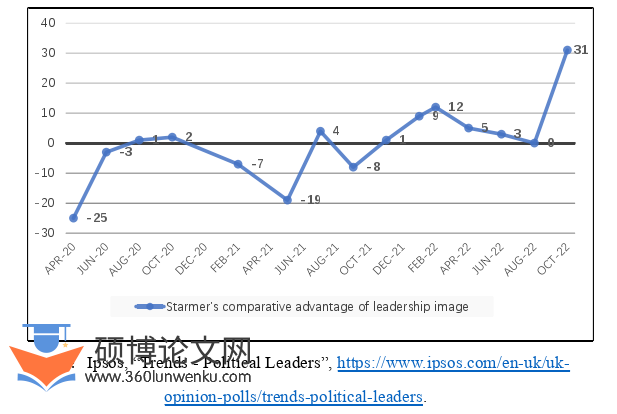
代写英语硕士论文领导力优势对比图
......................
1.2 Socio-economic Governance Credibility
Socio-economic governance credibility is a fundamental factor influencing voters’ preferences in British elections. Voters assess political parties based on their ability to manage economic activities and improve social well-being effectively. This includes fiscal, monetary, social, environmental, trade, labour, and industrial policies (Okunlola et al., 2023). A party’s socio-economic governance credibility is shaped by its ideological stance and its ability to address pressing socio-economic issues.
The Labour Party’s return to the moderate ideology under Starmer has been a strategic move to rebuild its socio-economic governance credibility. This shift has involved a pragmatic approach that emphasises economic stability and growth, aligning with the prevailing socio-economic conditions and voter concerns (Goes, 2021). Starmer’s focus on “securonomics” and a pro-business, pro-worker economic model has resonated with voters, particularly in the context of the NHS crisis and the cost-of-living crisis (Parker, 2024).
In contrast, the Conservative Party has suffered from a significant erosion of its socio-economic governance credibility. The failures of the Johnson, Truss, and Sunak governments to effectively manage the NHS crisis, the cost-of-living crisis, and broader economic challenges have led to widespread voter disillusionment (Ham, 2023; Resolution Foundation, 2023). The Conservatives’ mismanagement of these issues has resulted in a loss of public trust, thereby diminishing their electoral appeal.
.........................
Chapter 2 Comparative Advantage of Starmer’s Leadership Image
2.1 Leadership Image Comparison: Starmer vs. Corbyn
Corbyn used to demonstrate phenomenal voter attractiveness in most of his tenure. Starting with a backbench MP who was nominated as a symbolic candidate of the left, he took everyone by surprise with an overwhelming 59.5% first-preference votes electing him as the party leader on 12 September 2015 (Mason, 2015). The leadership election campaign during the summer of 2015 was remembered by hundreds of young Labour Party members turned out to hear Corbyn’s authentic, informal style speeches about radical left-wing policies, which was dubbed “Corbynmania” by the press (Nunns, 2018).
Corbyn’s triumph was not a mystery, neither an “accident”. The Conservative Party’s neoliberalist economic policies and New Labour’s modification of these policies were believed by the British people to be holding responsible for the 2008 financial crisis and its aftermath. Among Corbyn’s supporters, there are a significant proportion of younger millennial activists whose lives had been precarious because of the rising cost of university tuition and housing. Therefore, there was nothing strange about the comeback of the left politics as it could take a step back and criticise the current establishment. For the same reason, the rage of left politics was a global phenomenon. In the United States, over a half of 18 to 30-year-olds were reported to have a positive view of socialism. During the presidential election in 2016, there were more young voters supported Bernie Sanders than both Donald Trump and Hilary Clinton combined. For the young generation, the left politics had become “a form of identity or enjoyable pastime” (Diamond, 2021), representing “a cry of rage against the bleak future” (Hannah, 2018). However, this fanaticism was gone as fast as it came. Labour suffered a crushing defeat in 2019 and Corbyn was forced to step down in 2020. While broader factors such as the decline of left and the rise of right populism played significant roles, Corbyn’s mismanagement of his leadership image also contributed to this outcome.
..............................
2.2 Leadership Image Comparison: Starmer vs. Johnson, Truss and Sunak
Overall speaking, Starmer has been taking the lead in public favourability over Conservative leaders since the end of 2021, but it is hard to imagine that he could have beaten them at such a speed if not for the outbreak of the COVID-19 pandemic and the politically suicidal misjudgements made by the Conservative leaders afterwards.
Johnson used to be a strong opponent against Labour leaders who had been holding a safe lead since he took office in July 2019 (Ipsos 2024). According to an Ipsos survey (2020), when Starmer was elected leader of the Labour Party in April 2020, his comparative advantage in leadership image was left behind by 25 percentage points. It raised for a short time but then followed by a decline during the first half of 2021 when COVID restrictions were gradually called to an end and Johnson was pushing for COVID-19 vaccinations. The lowest ebb of Starmer’s relative advantage was in May 2021, when the “red wall” constituency of Hartlepool, which has historically been controlled by Labour, underwent a major defeat in the by-election. The Labour Party suffered a severe setback in the area, with up to 16% of Labour voters switching to the Conservative Party, a shift that resulted in Hartlepool changing hands for the first time since it was established in 1974 (Kuenssberg, 2021). Several commentators, including Tony Blair (2021), have publicly claimed that the Labour Party is facing an existential crisis due to the loss of working-class votes. Stammer’s popularity ratings also fell significantly as a result of Labour’s defeat in the Hartlepool by-election. On 21 May 2021, Stammer’s lead image advantage over Johnson fell to -19%, the largest decline in his leadership image advantage since he became Labour leader.
..........................
Chapter 3 The Comparative Advantage of the Labour Party’s Socio-economic Governance Credibility ........................ 24
3.1 Socio-economic Governance Credibility Comparison: Labour’s Pre-Starmer Era vs post-Starmer Era ...................... 26
3.2 Socio-economic Governance Credibility Comparison: Labour vs the Conservatives ................. 30
Chapter 4 Comparative Advantage of Labour Party’s Parliamentary Unity ............ 36
4.1 Parliamentary Unity Comparison: Labour’s Pre-Starmer vs post-Starmer Era............................. 37
4.2 Parliamentary Unity Comparison: Labour vs the Conservatives ................... 41
Conclusion .................. 47
Chapter 4 Comparative Advantage of Labour Party’s Parliamentary Unity
4.1 Parliamentary Unity Comparison: Labour’s Pre-Starmer vs post-Starmer Era
The Western social democratic parties have been plagued by internal frictions more frequently than the right-wing factions. For the British Labour Party, this problem is characterised by the enduring coexistence of left and right-wing factions within the parliamentary party, which have consistently engaged in dilemmatic bargaining and alternated in dominance (Wu, 2021). The debates cantered on whether the party should move right, focusing on improving public services and welfare to support the capitalist economy, or move left, emphasising government intervention in investment and ownership through structural reforms (Jacobs & Hindmoor, 2022). These debates were not limited to oral arguments but marked with revolts and defections that had impaired the party again and again.
Among the numerous disputes, three particularly traumatic “civil wars” stand out in the Labour Party’s history, occurring in the 1930s, 1950s, and 1980s. The first was the “1931 Betrayal” when Labour Prime Minister Ramsay McDonald implemented mass reductions in public expenditure to cope with the Great Depression (1929-1933), leading to an internal dispute within the party and McDonald was regarded as a “traitor”, as his policy was deemed as undermining Labour’s commitment to maintaining high public expenditure for the benefit of the working class, a principle that is central to the party’s socialist identity. After the incident, the Labour Party experienced a dreadful decline in the general election of 1931, with their parliamentary seats reduced a significant number of 237 (Brivati & Heffernan, 2000).

代写英语硕士论文参考
.....................................
Conclusion
The 2024 general election marked a significant turning point in the history of the British Labour Party, with Keir Starmer leading the party to a landslide victory. This achievement can be attributed to multiple factors that have collectively revitalised the Labour Party under Starmer’s leadership, reversing the fortunes that had plagued the party in the post-2020 era.
Firstly, Starmer’s leadership image played a crucial role in the party’s resurgence. Unlike his predecessor Jeremy Corbyn, whose leadership was marred by ambiguity on Brexit and allegations of antisemitism, Starmer presented himself as a pragmatic, principled, and empathetic leader. His ability to connect with voters on a personal level, combined with his reputation for integrity and competence, helped to rebuild public trust in the Labour Party. This was further enhanced by the comparative weaknesses of Conservative leaders such as Boris Johnson, Liz Truss, and Rishi Sunak, whose scandals and policy blunders significantly tarnished their own images and created a favourable contrast for Starmer.
Secondly, the Labour Party’s socio-economic governance credibility was significantly enhanced under Starmer’s leadership. The party’s shift towards a more centrist, pro-business stance, coupled with a focus on economic stability and growth, resonated with voters who were disillusioned with the Conservatives’ handling of the NHS crisis and the cost-of-living crisis. Labour’s emphasis on pragmatic solutions and its commitment to addressing long-standing issues such as healthcare and economic inequality helped to restore its reputation as a competent and responsible governing party.
reference(omitted)